Digital Marketing Strategy 101: Your Guide to Success

You probably think you are reading yet another article about digital marketing strategy, but before you validate that assumption and run away, let's reflect for a moment on why you are here. Do you just want to grow your business? Right? But then, the million-dollar question is where to start. How do you make your brand visible and unforgettable in a digital landscape, where attention is the new currency? To answer this question, we will need to dig deeper to craft a digital marketing strategy that fulfils that promise.
To answer this question, we first need to understand that it takes at least an average of 7 interactions with your brand before a purchase occurs (Marketing Rule of 7, Jonathan Hedger). This means we need to invest in every funnel stage and reflect this in our strategy.
Therefore, Our strategy should allow us to make every interaction with our target audience valuable and have clear goals depending on where they are in their journey.
What is a Digital Marketing Strategy? (And Why Most Get It Wrong)
Before we go into the how-to, let's clear up a common misconception. A digital marketing strategy isn't a to-do list of random tactics through various digital channels. A well-crafted digital marketing strategy is based on a set of choices we make to win in a particular market from a digital angle. We must have a clear vision of what short-term, medium-term, and long-term bets we will make to attract, engage, and convert our target audience. These bets will be linked to the channels where our target personas are and the type of activities we can run based on our budget and resources.
In short, it is the backbone of how we will establish and enhance our online presence and increase our digital footprint to achieve our specific goals. The key to a winning strategy is data. It is paramount that we can quantify the opportunities that are available to us and even more crucial ensure we have the right mechanisms to track and measure performance. This allows us to fine-tune our strategy as we grow.
The Secret Ingredients of a Head-Turning Digital Marketing Strategy
1. Goals That Make Your Heart Race
First things first: what do we want to achieve? This is not about our overall intent, of course, we want to grow the brand, and bring more sales, and more conversions, but when we talk about objectives we need to define where we want to focus on. This sounds easier than it is because we are talking about having goals at each stage of the funnel and our objectives need to be reflected across the customer journey.
Goals That Inspire Action
We need to be clear about what it is we want to achieve at each stage of the funnel:
Top of the funnel: where we want to ensure that we can enlarge it as much as possible, our focus will be on traffic generation quality of traffic and getting as much visibility for our brand across the overall Channel ecosystem.
Middle-of-the-funnel: where it will all be about driving that meaningful action. At this stage, we want to ensure that people are clicking and that our target audience is consuming our content and engaging with our brand. We need to build on that initial phase and start creating value for our target personas.
Bottom of the funnel: Here, the objective should be clear. The No.1 goal should be driving conversions and closing the sale. We want to make sure that at this stage, we have enough conversions to run optimisation experiments to systematically increase our chances of effectively converting every user who is ready to make that decision.
Only then we will be able to have a holistic strategy to ensure scalable success. And no, "more sales" isn't good enough. We're talking about goals that make your palms sweat and your pulse quicken. Want to be the go-to brand for eco-conscious millennials? Aiming to disrupt an entire industry? Now we're talking.
2. Know Your Audience Better Than They Know Themselves
You can't create a message that resonates if you don't know who you're talking to. Start by implementing systematic customer feedback loops, including the Sean Ellis test – asking customers "How would you feel if you could no longer use our product?" If at least 40% say "very disappointed," you've found your product-market fit and true audience understanding.
Are you struggling with low conversion rates despite high click-through rates? Having trouble convincing users to upgrade to your premium version? Wondering what makes your most loyal customers stick around? The answers lie with your customers – you just need to ask the right questions!
Get to know your audience's mind and feelings through continuous customer interviews, surveys, and behavioural analytics. What keeps them tick? Transform their feedback into actionable insights by categorizing responses into clear themes and prioritizing the most impactful pain points and desires.
Create buyer personas so vivid you could pick them out of a lineup, built not on assumptions but on real voice-of-customer data. Regular customer feedback sessions will help you validate these personas and uncover unexpected insights that your competitors might miss. Remember: the goal isn't just to collect data, but to understand your customers deeply enough to solve problems they haven't even articulated yet.
3. Spy on Your Competitors (Legally, Of Course)
Sun Tzu said, "Know your enemy and know yourself, and you need not fear the result of a hundred battles." While your competitors aren't enemies, the principle holds. Modern competitive intelligence tools make this easier than ever. Use SimilarWeb to analyze traffic patterns and user engagement, SEMrush to decode their SEO and content strategies, and SpyFu to uncover their paid advertising playbook.
Dive deeper with tools like Ahrefs to track their backlink profile and content performance, or Owler for real-time company updates and funding insights. Monitor their social media presence with tools like Brandwatch or Mention to understand their community engagement strategies and brand positioning.
Today's market intelligence platforms are increasingly comprehensive – you don't need a dozen different subscriptions. Choose tools that offer the most robust feature sets aligned with your specific goals. Many of these platforms will allow you to size your Total Addressable Market, while review sites like G2 Crowd and Capterra provide valuable insights into customer satisfaction levels and feature comparisons, helping you identify gaps in the market that your competitors haven't yet filled.
What are they doing well? Where are they dropping the ball? Most importantly, what unmet customer needs can you identify through this analysis? Find these gaps and prepare to drive a truck through them – not just with me-too features, but with innovative solutions that truly serve your target market.
The goal isn't just to match your competitors but to find underserved segments and opportunities they've missed. Combine this competitive intelligence with your customer insights to create a unique market position that's difficult to replicate.
4. Choose Your Weapons (Channels) Wisely
Not all digital channels are created equal, and each demands its own approach. While your audience might be scrolling through Instagram, swiping on TikTok, or buried in LinkedIn, don't forget YouTube – with over 2.5 billion monthly active users, it's not just a video platform but the world's second-largest search engine. Each platform has its own success metrics and native formats: what works in LinkedIn's professional environment won't resonate in TikTok's entertainment-first space.
Create platform-specific content:
Master the art of platform-specific content, with video becoming non-negotiable across all channels. YouTube rewards watch time and engagement, Instagram prioritises visual storytelling through Reels and Stories, LinkedIn values thought leadership (increasingly through video), and TikTok celebrates creative authenticity. The shift towards video isn't just a trend – it's how modern audiences prefer to consume content. Short-form, long-form, live streams, and interactive video content should all be part of your arsenal. It's better to be amazing on two channels than mediocre on ten – but ensure your chosen platforms cover both branding and performance marketing needs across your entire funnel. Remember: if you don't invest in building brand awareness at the top of the funnel, you'll struggle with conversion rates further down, no matter how optimized your performance campaigns are.
The rise of AI-powered conversational platforms like ChatGPT, Claude, and Perplexity is creating entirely new channels for reaching audiences. These platforms are increasingly multimodal – combining text, voice, and visual interactions – changing how people discover and engage with content. Voice search and audio interactions are becoming as important as text-based queries, while visual search capabilities are expanding rapidly. Your marketing strategy needs to consider how to be present and valuable across these various modes of interaction. This might mean optimizing your content for voice search, creating rich multimedia responses for AI queries, developing plugin integrations, or ensuring your brand shows up meaningfully in these AI-driven conversations where users are increasingly spending their time.
The Balance of Performance and Brand Marketing:
Balance is key: use performance marketing for immediate results and measurable ROI, but don't neglect brand-building activities that create long-term value and emotional connections. Your top-of-funnel content builds trust and recognition that makes mid and bottom-funnel conversions more effective. Think of it like this: performance marketing harvests demand, while brand marketing creates it. You need both to thrive in today's complex digital landscape.
The most successful strategies combine:
- Short-term performance metrics (clicks, conversions, ROI)
- Long-term brand building (awareness, trust, loyalty)
- Platform-specific content optimisation
- Multimodal presence across traditional and AI-powered channels
- Strong video and audio content strategy
- Consistent presence across all funnel stages
5. Content That's Worth Talking About
Your content strategy should aim to create pieces so good, so useful, and so entertaining that people can't help but share them. Think "purple cow" as Seth Godin would say—be remarkable or be invisible. But remarkability isn't random; it's methodical. Start with deep audience insights, identify content gaps through tools like BuzzSumo or Ahrefs Content Explorer, and create content that solves real problems or entertains in unique ways.
Building a content moat requires a systematic approach to content creation and optimisation. Leverage tools like Clearscope, Frase, or MarketMuse to understand search intent and ensure comprehensive topic coverage. These AI-powered platforms analyse top-performing content and provide data-driven recommendations for:
- Topic clusters and semantic relevance
- Content depth and breadth requirements
- Keyword optimisation without sacrificing readability
- Competitive content gaps and opportunities
The key components of a sustainable content moat include:
- Topic Authority: Build deep expertise in specific areas through comprehensive pillar content and supporting articles
- Content Depth: Create thorough, well-researched pieces that address user intent at every level
- Update Frequency: Regularly refresh existing content to maintain relevance and search positions
- Internal Linking: Develop a strong website architecture that helps users and search engines navigate your content
- Content Formats: Diversify across text, video, audio, and interactive content to cater to different learning styles
- Data-Backed Insights: Support your content with original research, surveys, or unique data points
- Distribution Strategy: Develop multiple channels to reach your audience where they are
Mix evergreen content that builds long-term authority with timely pieces that capture momentum. Your content calendar should balance:
- Foundational pieces that address core topics
- Trend-based content that shows industry leadership
- Updated legacy content to maintain relevance
- User-generated content to build community
- Expert collaborations to extend reach and authority
Quality content isn't just about what you say—it's about timing, format, and distribution strategy. One viral hit backed by paid amplification can outperform months of mediocre posts. But true content moats are built through consistent, high-quality output that serves your audience's needs whilst differentiating your brand from competitors.
6. Budget Like a Boss
Money makes the world go round, and it certainly fuels your digital marketing strategy. But here's the twist: it's not about how much you spend, it's about how smartly you spend it. Start with a 70-20-10 framework: 70% on proven channels and tactics that consistently deliver results, 20% on emerging opportunities with strong potential, and 10% on experimental initiatives that could become tomorrow's growth engines. Track your Customer Acquisition Cost (CAC) against Customer Lifetime Value (CLV) for each channel, and be ready to pivot based on data, not assumptions. Consider seasonal trends, competitive pressure, and market conditions when allocating budget. Most importantly, maintain flexibility—the ability to quickly shift resources to high-performing channels can be more valuable than any preset budget allocation.
7. KPIs That Mean Something
When it comes to KPIs, everything depends on your business goals, strategy, and most importantly, your North Star Metric (NSM). Take Facebook's pivotal shift to focus on daily active users from monthly active users as their NSM – this single metric guided their entire product development and growth strategy. Your North Star Metric should be the one measurement that best captures the core value your product/service delivers to customers.
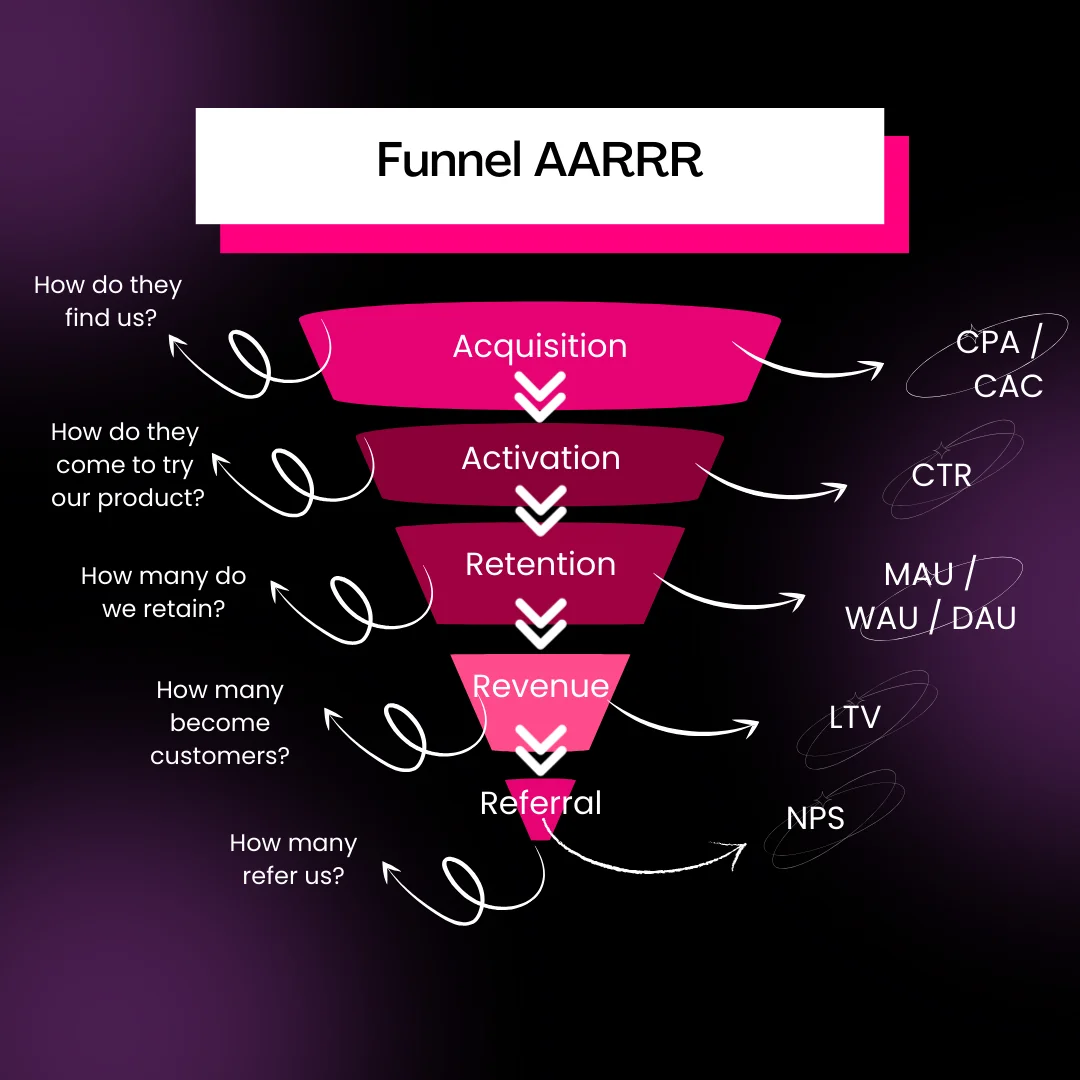
Growth Hacking - Pirate Funnel
Growth-focused businesses often adopt frameworks like Dave McClure's AARRR (Pirate Metrics) funnel to systematically measure and optimise their growth efforts. Let's break down essential KPIs through this lens:
Acquisition (How do users find us?)
Key Metrics:
- Customer Acquisition Cost (CAC)
- Channel-level Cost per Acquisition (CPA)
Activation (How do they start engaging with our product/service?)
Key Metrics:
- CTR
- User Sign-Up Rate
- Onboarding completion rate
- Time to First Key Action
- Activation Rate
Retention (How many do we retain?)
Key Metrics:
- Daily/Weekly/Monthly Active Users (DAU/WAU/MAU)
- Churn rate
- Retention Rate
Revenue (How many become customers?)
Key Metrics:
- Customer Lifetime Value (CLV)
- Average Revenue Per User (ARPU)
- Conversion Rate
- Repeat Purchase Rate
Referral (How many refer us?)
Key Metrics:
- Net Promoter Score (NPS)
- Viral coefficient
- Referral conversion rate
These metrics shouldn't exist in isolation. Create dashboards that show the relationships between these KPIs and your North Star Metric. For instance, how does improved activation affect long-term retention? How do different acquisition channels impact CLV?
- Focus on leading indicators that help predict future performance
- Ensure metrics are actionable – if you can't influence it, don't track it
- Regularly review digital marketing strategy and adjust your KPIs as your business evolves
- Don't track everything just because you can – focus on metrics that matter for your current growth stage
- Consider both quantitative and qualitative data for a complete picture
The key is to build a measurement framework that aligns with your business model and growth stage while remaining flexible enough to evolve as your business matures and your goals shift.
Building and running that framework takes senior judgement week after week. If your team doesn't have that in-house, a fractional CMO can set the strategy, pick the metrics that matter and lead the execution at a fraction of the cost of a full-time hire.
Want to implement these strategies for your business?
Contact us to learn how we can help, or explore our services.